
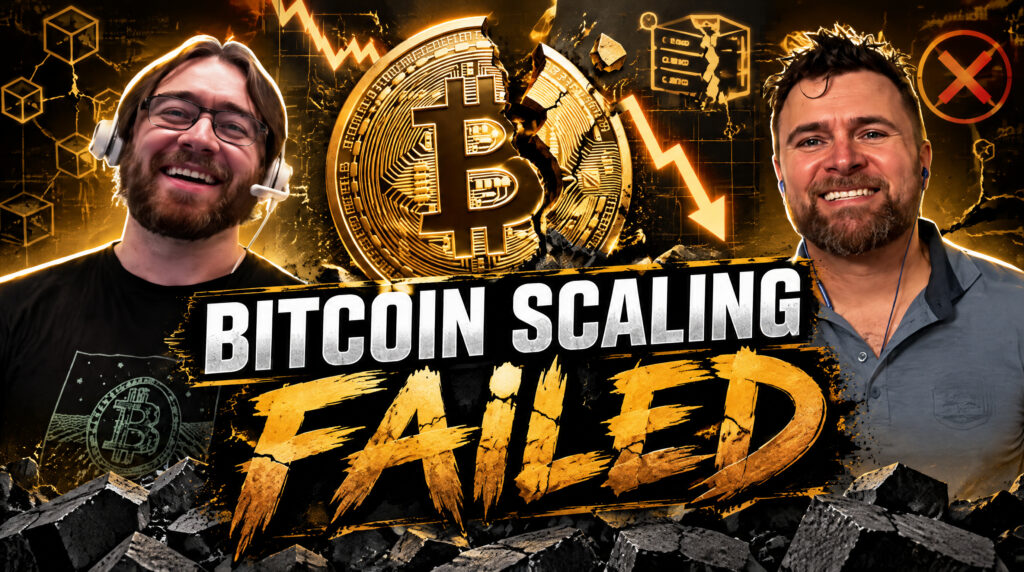
Bitcoin Scaling Failed… eCash’s October Fork Is About to Capitalize
What up, Vigilantes?
I have some news for you…
Rusty Russell just quit Lightning development. The man who helped build Bitcoin's flagship Layer 2 walked away, and nobody should be surprised. Lightning's usability was always “send five transactions and hopefully one lands.” That's not a payments network. That's a coin flip with extra steps.
And the devs didn't just leave Lightning. They fled to Ark Protocol and BitVM. Meanwhile, Elements, Blockstream's federated sidechain model, got hacked. An inflation bug in confidential transactions cost roughly 4,000 BTC, and about 3,600 were returned. This was a feature with formal mathematical proofs of safety. Proofs! The irony, as JK put it on the show: “You could have a catastrophic failure and then your formal methods, like specification and math… doesn't really count anymore.”
So Bitcoin's scaling scorecard is 0-for-2. And while Core ossifies, a fork is coming that could absorb the entire altcoin market…
Watch on: Odysee | YouTube | X | Rumble | Bitchute | Vigilante.tv
Here's the uncomfortable truth: scaling didn't fail technically. It failed culturally. Paul Sztorc's BIP 300/301 drivechain proposals went nowhere from 2015 to today, not because they didn't work, but because ossification culture, as JK said, has “taken the wind out of everybody's sail.” The forks are happening in culture, not code. And when BitVM and Ark get pre-approved as consensus in what JK called “Bitcoin Core secret meetings,” you start to understand who actually decides what Bitcoin is.
Then there's the cap itself. Peter Todd is pushing tail emissions and a demurrage idea that would tax your wallet to pay miners. And BlackRock's own commercial disclaimer says the 21 million cap is “subject to change.”
The 21 million cap is Bitcoin's whole pitch. If that's negotiable, what isn't?
Which brings us to October. eCash is forking in roughly six weeks, and the design is beautiful in its simplicity: Bitcoin Core's exact codebase plus a single change, BIP 300 and BIP 301. That's it. There's no replay protection either, which means holders have to actively split their coins and miners have to actively choose between chains. This fork packs a real punch.
BIP 301 is blind merge mining: every main-chain block includes a commitment to a sidechain block, and that sidechain block only becomes valid once the main-chain block is valid. Miners can't give their hash rate away for free anymore. They have to choose.
And the sidechain ecosystem? It's exploding. There's ETHside, an Ethereum clone compatible with Ethereum wallets; Zside, a Zcash-style chain; Thunder, with big blocks and instant payments via double-spend bonds; Truthcoin prediction markets; and CoinShift, a decentralized market maker for atomic swaps. Then there's JK's own Elements Plus. In his words, “I took all their research and just switched the one flaw… the pegging and peg out mechanism.” He swapped the federated peg for BIP 300/301, baking the lessons of the Elements hack right into the design.
My thesis, and I said it straight to JK: SHA-256 will consume the entire altcoin market. Any altcoin, whether it's Solana, Zcash, or Hyperliquid, could be recreated as a drivechain on eCash. Given how quickly the crypto space has grown, and all the scaling tech clashes and the on-chain horizon we've covered before, this is the next chapter of making Bitcoin fun again.
Why build on a less secure chain when you can plug into the most secure protocol on Earth?
Alpha and beta testnets are already live. Watch the full interview, and follow the eCash Telegram at ecash.com.
Follow me on X @VamosVigilante
Want to be on the pulse of crypto? Access our exclusive portfolio, insider reports, full archive of monthly newsletters, real-time market updates, buy/sell alerts, and private community chat and get instant access to the latest issue of our monthly newsletter… Subscribe now!
FREE “Crypto 101” Video Training – Watch Our Millionaire Crypto Analyst Reveal the Exact Crypto Wallet Setup He Wished He Had When Starting Out: https://CryptoVigilante.io/crypto101
TCV Summit: “What Matters Most in Crypto” | https://dollarvigilante.spiffy.co/checkout/what-matters-most ⬅️ Replay videos available!
The Crypto Vigilante (Follow on All Socials)
Podcast: Play in new window | Download
Subscribe to the TCV podcast: Apple Podcasts | Spotify | Amazon Music | RSS | More
